
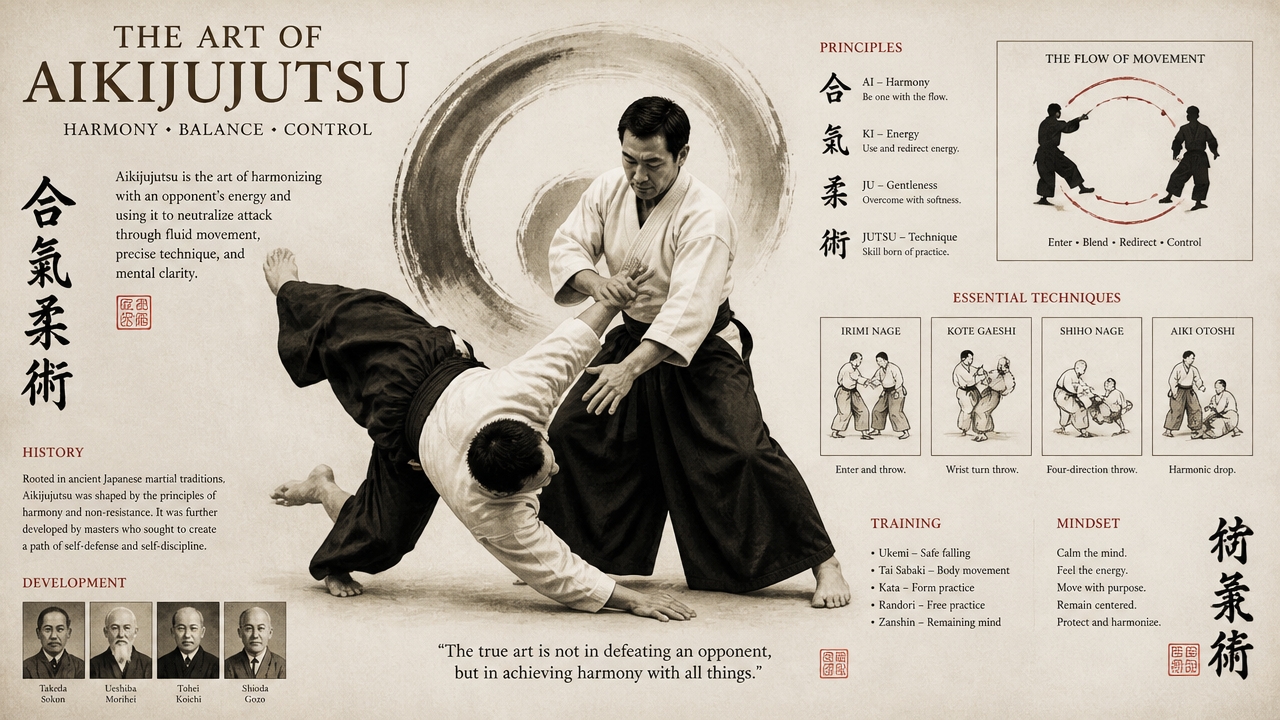
Within the chronicles of Japanese bujutsu, the art designated as Aikijujutsu (合気柔術) constitutes a distinct and formidable lineage, one whose technical corpus is predicated upon the synergistic application of kansetsu-waza (joint-seizing techniques), nage-waza (throwing techniques), osae-waza (pinning techniques) and atemi (percussive strikes). Its operative principle, the esoteric concept of *aiki*, does not posit a collision of opposing forces; rather, it dictates a dynamic of confluence, a redirection of the assailant’s kinetic trajectory such that their own commitment becomes the instrument of their subjugation.
In genealogical terms, this system finds its most definitive and historically verifiable expression in the branches of Daitō-ryū Aiki-jūjutsu, the ancient house tradition from which it draws its most complete technical charter. It is from this formidable rootstock that the modern synthetic arts, principally Aikido, as promulgated under the aegis of Ueshiba Morihei and the Korean composite of Hapkido, have drawn their foundational scaffolding, albeit with significant philosophical and tactical modifications that distinguish them from their austere progenitor.
Core Principles and Techniques
Rather than relying on muscular strength, practitioners use precise body alignment, timing and core rotation to destabilize an attacker upon contact.
- Aiki (Harmonizing Energy). Practitioners blend with an incoming attack, using subtle hip and spine movements to disrupt the opponent’s center of gravity.
- Joint Manipulation (Kansetsu-waza). Techniques apply angular, leverage-based pressure to wrists, elbows and shoulders to control or disable an adversary.
- Throws and Pins (Nage-waza and Osae-waza). Once an opponent’s balance is broken (kuzushi), spherical or linear movements project them to the ground and immobilize them.
- Vital-Point Strikes (Atemi). Deceptive strikes to vulnerable areas are used to distract, stun or open up an opponent for a lock or throw.
Watch this demonstration at the Nippon Budokan to see how Daitō-ryū practitioners use subtle balance disruption and joint locks to control attackers:
Historical Origins
The art traces its traditional lineage to the 11th century with samurai commander Minamoto no Yoshimitsu. It was passed down as a secret fighting system within the Takeda clan of the Aizu domain for generations. In the late 19th century, Takeda Sōkaku (1859–1943) systematized the curriculum and began teaching Daitō-ryū Aiki-jūjutsu publicly across Japan.
- Fudal Roots: The system traces its foundational techniques to ancient samurai traditions of feudal Japan, historically preserved within the Takeda family of the Aizu domain.
- Public Introduction: It was systematized and brought to the public in the late 19th and early 20th centuries by Takeda Sōkaku.
- Influence on Other Arts: Daitō-ryū is the direct parent or major influence behind modern Aikido (founded by Takeda’s student Morihei Ueshiba) as well as Hapkido and other systems.
Aikijujutsu vs. Aikido
While Aikido evolved directly from Takeda Sōkaku’s teachings through his student Morihei Ueshiba, the two arts differ significantly in intent and execution.
| Feature | Aikijujutsu (Daitō-ryū) | Aikido |
| Primary Focus | Combative effectiveness, self-defense and subduing an attacker. | Personal development, harmony and mutual safety during practice. |
| Technique Execution | Tight, angular joint locks, strikes (atemi) and hard takedowns. | Flowing, circular movements designed to let partners roll out safely. |
| Training Method | Partnered kata (pre-arranged forms) emphasizing subtle internal mechanics. | Cooperative dynamic drills and partnered forms. |